From Beninese cashew to cream liqueur: how WAKIZA is trying to create a new category of African spirits
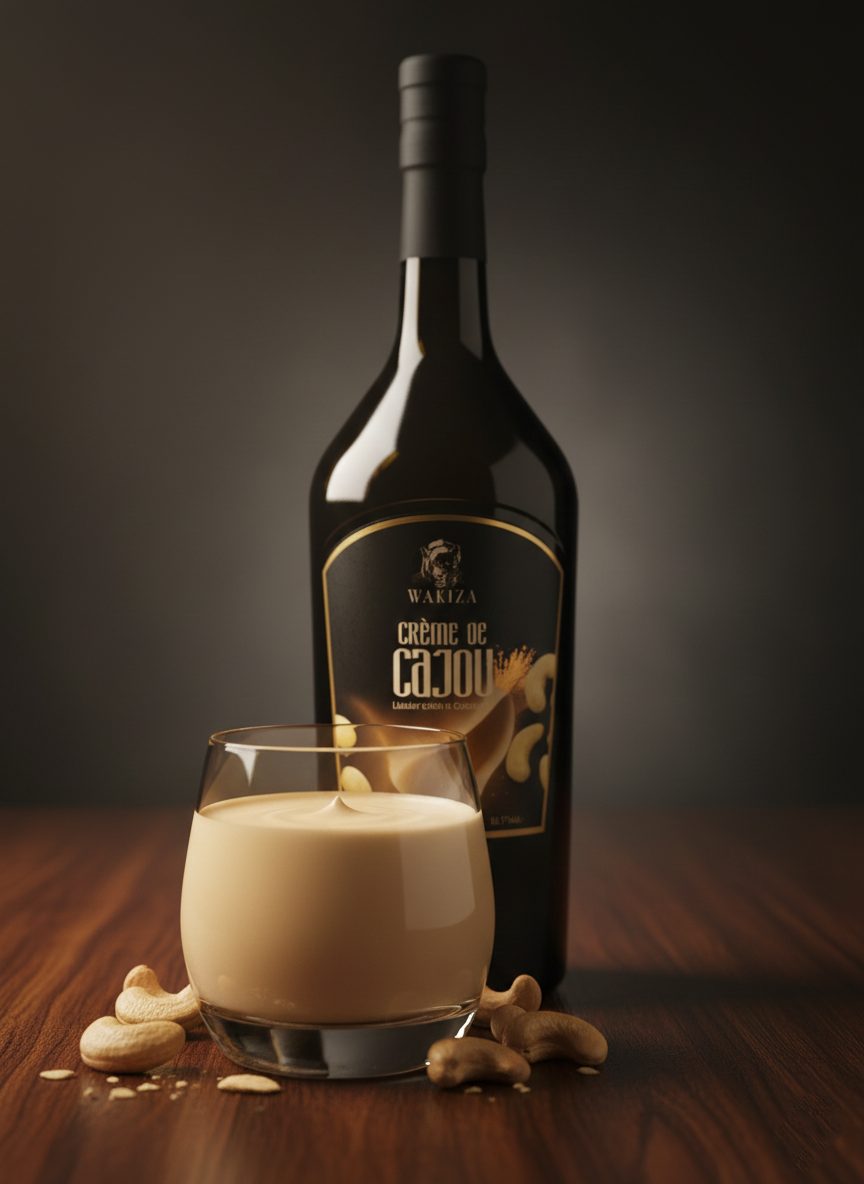
In Benin, a young spirits brand is trying to push cashew into new territory: no longer treating it solely as an agricultural raw material exported as kernels, but as the starting point for a premium alcoholic experience. With WAKIZA Caju, WINEX GLOBAL INDUSTRIES wants to transform one of West Africa's flagship agricultural products into a cashew cream liqueur aimed at the regional market and, eventually, international consumers.
Behind this innovation lies a technical equation far more complex than it appears: successfully transforming the natural richness of the cashew nut into a creamy, homogeneous, stable beverage, while preserving the raw material's aromatic signature and controlling its behavior within an alcoholic matrix.
Turning an export commodity into a tasting experience
The principle sounds simple: take the cashew nut, extract a creamy matter from it, and blend it into a liqueur.
In reality, that's exactly where the difficulty begins.
Cashew is mainly valued through its kernel, a raw material whose international outlets have historically been dominated by the food industry. In Benin, as in several West African producing countries, a significant share of the industry's economic value remains tied to processing and selling the kernel.
WAKIZA Caju approaches the problem from a different angle.
What if cashew no longer served only to produce a kernel to sell, but became the very flavor identity of a spirit?
That idea is the origin of WAKIZA Caju, a cashew cream liqueur developed by WINEX GLOBAL INDUSTRIES in Benin.
The brand is thus working on a category still under-represented in the international cream liqueur landscape: an alcoholic cream in which cashew forms the central signature.
The difference matters.
This isn't simply about flavoring a liqueur with a cashew aroma. The ambition is to build a genuine creamy matrix around the raw material, so the nut simultaneously delivers its taste, its roundness, and its texture.
The real challenge: making cashew hold together in a bottle
Cashew has a particularly interesting characteristic for a creamy application: it can be transformed into a fine, rich, smooth matter.
But once it meets alcohol, sugar, and the other components of a liqueur, the balance becomes far more delicate.
A cream liqueur must maintain several properties at once:
- a sufficiently smooth texture;
- an even dispersion of fat content;
- a pleasant mouthfeel;
- good physical stability;
- a consistent appearance;
- resistance to separation;
- and a recognizable aromatic identity.
In other words, the challenge isn't just creating a recipe that works on production day. It's building a formulation capable of remaining a commercial beverage.
This dimension is what turns the WAKIZA Caju project from a simple culinary experiment into a genuine food-industry innovation challenge.
Cashew cream already exists as a food preparation, notably in plant-based cuisine and culinary applications. It's generally obtained from ground, hydrated cashew nuts to achieve a creamy texture.
WAKIZA's additional challenge is to adapt that logic to the world of spirits.
From nut to emulsion technology
To achieve a stable cream liqueur, WAKIZA is working on a combination of several technological levers.
The cashew matter must first be fine enough to produce a smooth, consistent mouthfeel.
It must then be integrated into an alcoholic phase without triggering rapid separation between the different phases.
The formulation draws notably on functional ingredients used to manage texture and stability in food systems, along with a high-pressure homogenization step.
This last step is an important part of the industrial process WINEX is planning.
Homogenization reduces the size of particles and droplets in the product to achieve a more even dispersion. In a cream liqueur, this control over physical structure is essential to prevent the product from behaving like a simple cashew preparation mixed with alcohol.
The goal is to move from a recipe to a reproducible technology.
It's precisely this shift in scale that allows a food innovation to become an industrial product.
Why cashew is a particularly interesting candidate
Cashew already carries a strong international image.
It's eaten as a nut, used in confectionery, pastry, sauces, plant-based beverages, and various culinary preparations. Its naturally creamy texture also makes it a sought-after raw material in several food applications.
But its potential in spirits remains far less explored.
That's precisely the space WAKIZA is trying to occupy.
In the world of cream liqueurs, consumers are mainly familiar with profiles built around coffee, cream, chocolate, fruit, or certain nuts.
Cashew opens a different path.
It brings a softer, rounder, more indulgent profile, well suited to a premium tasting experience.
WAKIZA Caju is thus trying to turn cashew from a mere ingredient into a spirits signature.
An innovation that starts in Benin but isn't confined to the Beninese market
The choice of cashew is obviously not neutral.
West Africa has become a major cashew production hub, while a significant share of the industry's added value continues to be captured outside producing countries.
For African companies, the challenge is no longer simply about increasing production volumes.
It's also about climbing the value chain.
Turning a raw nut into a kernel is already a first step.
Turning the kernel into a food ingredient is a further step.
Creating, from that raw material, a branded, packaged, marketed product sold directly to consumers represents yet another level of value creation.
This is the logic behind WAKIZA Caju.
The project isn't about competing with major cashew exporters on their own turf.
It's about pursuing a different kind of value: that of final processing, branding, and the consumer experience.
A category still to be built
The international market has long been familiar with cream liqueurs.
Coffee cream, nut-based liqueurs, and various creamy beverages have proven there's a customer base for softer, more indulgent, easy-to-enjoy spirits.
But formulations specifically built around cashew remain far less visible.
Cashew can be found, for instance, as a food cream used in certain cocktails, notably as a plant-based alternative in creations inspired by the White Russian.
But a cashew cream used as a cocktail ingredient is not the same as an industrialized, commercialized cashew cream liqueur sold as a finished product.
That is precisely the line WAKIZA is trying to cross.
The ambition, then, is broader than launching a new bottle.
It's potentially about creating a new reference point on the world map of cream liqueurs.
Betting on taste before storytelling
For WINEX, however, WAKIZA Caju's success cannot rest on its story alone.
The "African cashew" argument can grab attention.
The technological innovation can spark curiosity.
But ultimately, it's the taste that has to convince.
The tasting experience must deliver a creamy texture, a round mouthfeel, and a cashew profile identifiable enough that the consumer immediately understands what they're drinking.
That's where the real test of this kind of innovation lies.
Consumers shouldn't need to know the history of the cashew industry to enjoy WAKIZA Caju.
They simply need to taste it and think:
A bottle between fine dining, mixology, and premium spirits
WAKIZA Caju also has a strategic advantage: its use isn't limited to straight tasting.
Served chilled, the cream liqueur can be enjoyed on its own as a digestif or a sipping drink.
It can also become a mixology ingredient.
Cashew's texture and indulgent profile open the door to pairings with coffee, chocolate, vanilla, tropical fruit, or various dessert creations.
It can thus find its place across three worlds: sipping spirits, cocktails, and fine dining.
This versatility matters for a young brand trying to build its market.
Because a new category doesn't develop on shelves alone.
It also develops in bars, restaurants, hotels, cocktails, and tasting experiences.
From agricultural value creation to brand building
The story of WAKIZA Caju ultimately describes a deeper transformation.
The first transformation is turning the raw nut into something else.
The second is turning that matter into a stable formulation.
The third is turning that formulation into a branded product.
And the fourth is turning the product into a commercial category.
That last step will be the hardest.
Because creating a bottle is relatively simple.
Creating a market around a bottle is far more complex.
This is precisely the challenge WINEX wants to take on with WAKIZA.
The company isn't just trying to sell one more liqueur in the Beninese or West African markets. It wants to build a range of spirits capable of traveling — products that combine African raw materials, formulation innovation, and contemporary premium codes.
Cashew as a new raw material for African spirits
The story of cashew in Africa could therefore take a new direction.
For decades, the central question has been production, collection, shelling, and export.
The next battle could be over final processing and brand ownership.
That's where companies like WINEX want to position themselves.
With WAKIZA Caju, the bet is particularly bold: take a raw material known worldwide and give it a form consumers wouldn't spontaneously associate with cashew.
A liqueur. A cream. A spirit. A new experience.
If the market responds, the stakes will go far beyond the success of a single bottle.
It will demonstrate that an African agricultural raw material can become, on its own continent of origin, the starting point for a premium consumer product destined for the whole world.
And perhaps that is where WAKIZA Caju's real innovation lies:
no longer just exporting African cashew, but exporting what can be made from it.